

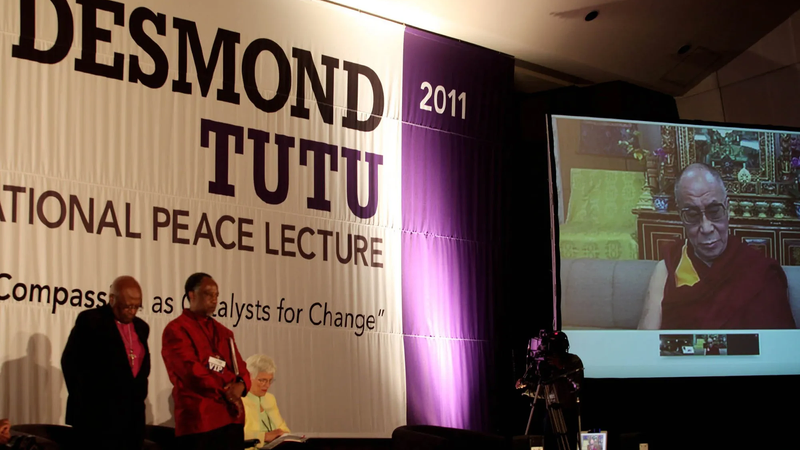
The Archbishop Desmond Tutu Intellectual Property (IP) Trust has raised serious concerns over the use of the late Archbishop’s name and legacy in connection with the Global Assembly of the World Movement for Democracy (WMD). The Trust, acting as the guardian of Tutu’s intellectual property and legacy, has strongly opposed the event’s links to U.S. government funding, particularly in light of America’s controversial role in the ongoing conflict in Palestine. In a letter sent to the CEO and Board of the Desmond & Leah Tutu Legacy Foundation, the Trust expressed its opposition, highlighting the potential perception of endorsement for U.S. actions in Palestine. The Trust noted that the United States has been supplying arms to the Israeli military and using its veto power at the United Nations to block resolutions condemning the violence in Palestine. This, the Trust argues, contradicts Archbishop Tutu’s lifelong commitment to justice and support for oppressed people.
“As you are aware, the Tutu IP Trust was established by the late Archbishop Desmond Tutu, who expressly recorded his wish that the Trust be established primarily to act as guardian and custodian of the intellectual property rights and legacy associated with Archbishop Tutu,” the letter reads. “Our client is of the view that the Foundation’s participation in the WMD Assembly will be perceived as support for the National Endowment for Democracy (NED), which is closely linked to U.S. government interests.” The Trust warned that such participation would be seen as insensitive to current geopolitical tensions, particularly the ongoing conflict in Palestine, and could have negative consequences for the Archbishop’s reputation. The letter, signed by Dr. Mamphela Ramphele, Chairperson of the Trust, further stressed that the Archbishop had always advocated for the rights of oppressed peoples, and any association with an event funded by those supporting actions in Palestine would be seen as a betrayal of his principles.
Despite the Foundation’s assurance that it does not support the war on Palestinians, the Trust emphasized that even symbolic participation would be harmful to Tutu’s legacy. The Trust also requested that the Archbishop’s name or image not be used in connection with the WMD event and that the planned exhibition of his work be removed immediately. Dr. Ramphele emphasized the importance of safeguarding Archbishop Tutu’s legacy, saying, “The Archbishop was always on the side of the oppressed. To associate his name with an event funded by those supporting atrocities is to betray his values.” The Desmond & Leah Tutu Legacy Foundation has acknowledged the Trust’s concerns and noted that it had consulted with a Palestinian delegation. The Foundation also plans to issue a joint statement at the end of the assembly, underscoring its stance on Palestinian rights. However, the Trust remains firm in its position, stating that participation in the event, regardless of the Foundation’s intentions, could be viewed as insensitive in light of current global events.
This dispute underscores the challenges faced in managing Archbishop Tutu’s legacy, particularly given his outspoken advocacy for human rights and his vocal support for Palestinian rights. It also raises important questions about the balance between honouring his legacy and engaging in international forums that may not fully align with his values.
Calls to boycott Black Friday rise among climate emergency activists

Environmental activists are urging the international community to boycott one of the year’s most anticipated shopping events, Black Friday, citing its severe environmental consequences. Originally coined in 1951 by Factory Management and Maintenance, the term “Black Friday” refers to the post-Thanksgiving shopping frenzy in the United States, which has since spread globally. The day is renowned for its deep discounts and high consumer demand, but this surge in consumption comes with a hefty environmental cost. According to The Ethical Consumer, Black Friday 2023 alone resulted in the emission of 429,000 tonnes of carbon dioxide, primarily from the transportation and delivery of goods. This surge in demand for clothing, electronics, and accessories has further exacerbated environmental concerns, with much of the plastic packaging used for these products either ending up in landfills or incinerated, or at best, recycled in low-quality processes. The publication stressed that only a small percentage of these products are recycled efficiently, with the majority contributing to the growing problem of waste and pollution.
“Clothing, accessories, electronics, and cosmetics are among the most popular Black Friday purchases. It has been estimated that 80% of electronics and clothing, plus the plastic packaging they are wrapped in, end up in landfill, incineration, or at best low-quality recycling after a very short life. We are not cutting consumption fast enough to avoid climate meltdown,” The Ethical Consumer warned. Among the notable voices calling for a boycott is minimalist YouTuber Exploravore, who shared her concerns in a video on social media. “Black Friday is the Super Bowl Sunday of consumption in America, but it has devastating effects on the planet,” she stated. “We can do better as humans. Join me in taking a stand against the consumer madness that dominates the holiday season and choosing to focus on what really matters.” Exploravore, a vocal critic of consumerism, pointed out that while carbon emissions have slowed in growth, actual emissions continue to rise, primarily due to the production of unnecessary goods. “We are still in a lot of trouble as a planet… the biggest piece of the carbon emissions comes from the production of goods we don’t need,” she explained, emphasizing the disproportionate impact that developed nations have on global emissions.
The growing movement has garnered significant support. Circular Online reported that over 14 million people are willing to join the global boycott of Black Friday, highlighting the concerns of waste generation during the shopping event. “The waste our nation generates is a huge issue all year round, but is exacerbated at this time of year, as seemingly large discounts persuade people to buy items they don’t need and can’t always afford,” the media outlet noted. As the debate over the environmental toll of Black Friday intensifies, activists and environmentalists are calling for more sustainable shopping habits and a shift away from mindless consumption. The call to action is not just about reducing waste, but about rethinking the role of consumerism in the context of a warming planet.