


The Minister of Trade, Industry, and Competition, Parks Tau, has filed an appeal against the Competition Tribunal’s recent order to prevent Vodacom from merging with fibre operator Maziv, the parent company of Vumatel and Fibre Africa. The merger, valued at R13 billion, was set to see Vodacom acquire a 30% stake in Maziv, a deal that has sparked significant debate regarding its potential impact on competition in South Africa’s broadband market. The Competition Commission had previously argued that the merger would reduce competition in the telecommunications sector. It warned that the deal could lead to irreparable structural damage, as it would create an entity with the power and incentive to engage in anti-competitive practices. The commission expressed concerns that this would have long-lasting, negative consequences on the broadband market, particularly in terms of market concentration and pricing power.
In late October, the Commission officially recommended that the merger should not proceed, and the Competition Tribunal upheld this decision. However, Minister Tau has now filed a notice of appeal, seeking a review of the Tribunal’s ruling. He has requested detailed reasons behind the Tribunal’s decision to block the merger, stating that once these reasons are provided, the Ministry will assess the situation and advise on the next steps. Minister Tau emphasized that his involvement in the merger proceedings was based on public interest grounds, which included commitments to boost investment, create jobs, and expand fibre and mobile connectivity in underserved communities. His spokesperson, Yamkela Fanisi, highlighted that the merger could have significantly advanced South Africa’s digital infrastructure, particularly in lower-income areas where connectivity is lacking.
Vodacom has expressed its shock and disappointment at the Tribunal’s decision. CEO Shameel Joosub voiced the company’s surprise, stating that Vodacom had planned to invest up to R14 billion into Maziv. Vodacom argues that this investment would have been a game-changer for South Africa, particularly in terms of providing greater access to digital infrastructure and creating thousands of jobs in communities with limited connectivity. “We believe South Africa desperately needs additional significant investment, especially in digital infrastructure in lower-income areas. Our investment would have positively impacted millions of lives and fostered economic growth,” Vodacom said in a statement following the Tribunal’s ruling. The outcome of Minister Tau’s appeal, along with any potential appeal by Vodacom, will have significant implications for the future of the South African broadband market. As the government, regulators, and companies await further developments, the focus remains on balancing competition concerns with the need for infrastructure development and economic growth in the country’s digital sector.
Huawei’s All-Optical smart-home showcase unleashes a new era of home connectivity in Africa
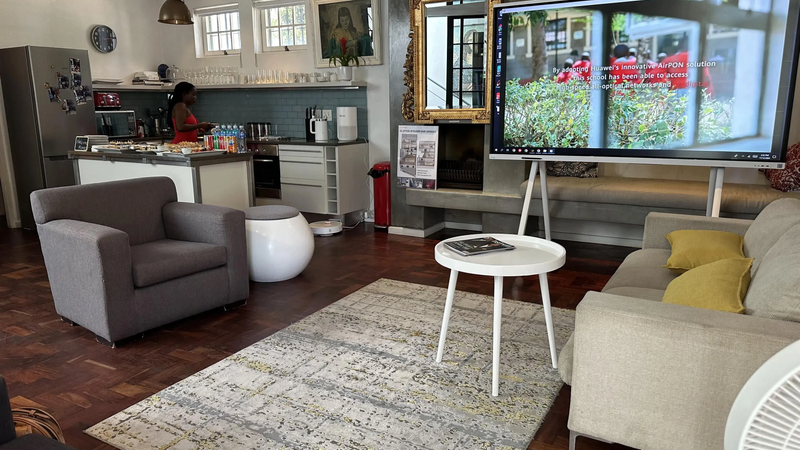
Huawei has successfully launched its All-Optical Intelligent Home showcase during the Africa Tech Festival in Cape Town, introducing an innovative solution for modern homes. Powered by the company’s cutting-edge Fibber to the Room Solution (FTTR F50), the showcase demonstrated how homes with complex layouts can achieve consistent, high-speed coverage using Huawei’s customer-friendly adhesive fibre cables. Located in the historic and picturesque Bo-Kaap neighbourhood, the intelligent showhouse was fully equipped with a range of advanced fibre broadband applications within a sleek South African home. Visitors experienced over 100 Internet of Things (IoT) devices integrated into the home’s systems, including smart lights, speakers, kettles, cameras, and sweeping robots, all running seamlessly thanks to the FTTR F50 solution. The FTTR F50 ensures that Wi-Fi speeds of up to 1Gbps are consistently maintained throughout the home, creating a seamless and high-performance digital environment for all users. In lounge areas, automated lighting, temperature control systems, and smart cleaning robots offer added convenience. Entertainment rooms benefit from stable, high-bandwidth connections, enabling 4K and high-resolution displays without lag or interruptions. Visitors were able to experience the latest game Black Myth: Wukong with zero latency, thanks to the robust FTTR connection.
The solution also enhances home offices by enabling smooth live streaming and providing support for smart conference rooms with 360-degree video and ultra-wide monitors. This makes remote work more efficient and reliable, offering better virtual collaboration. In the nursery, FTTR F50 facilitates easy monitoring through intelligent nanny cameras and temperature sensors. In the kitchen, smart lighting, voice-activated speakers, and appliances like kettles and air purifiers make meal preparation and home management more enjoyable. The intelligent home can support up to 128 IoT devices on a single network, with an enterprise version capable of handling up to 300 simultaneous connections. Huawei’s Self-bounding Transparent Fibber cable, which is both thin and virtually invisible, can be easily installed without the need for power tools or major home remodelling. Additionally, Huawei’s Link Home app enables homeowners to manage their home’s services remotely, from optimizing power usage to troubleshooting connected devices, all from their smartphones.
The exhibition was well-received, attracting over 150 guests, including network operators, business leaders, and media from across Sub-Saharan Africa, including South Africa, Kenya, Nigeria, Tanzania, Eswatini, and Namibia. These discussions underscored the potential impact of FTTR technology in advancing digital infrastructure across the region. In Sub-Saharan Africa, demand for higher-speed fibre-to-the-room solutions is growing, particularly as countries like South Africa, Mauritius, and Kenya officially launch Gigabit services. Huawei’s FTTR F50 addresses common challenges such as Wi-Fi dead zones, ensuring stable, high-speed coverage in every room of the house, including additional structures like cottages, home offices, and even pool houses. As fibre-to-the-home services become more widespread with speeds ranging from 100Mbps to 1Gbps, Huawei’s FTTR F50 solution ensures that users can fully leverage these speeds across their homes, driving the next phase of Africa’s digital transformation. The successful showcase at the Africa Tech Festival is expected to lead to more operators adopting FTTR solutions as they recognize its potential to transform home connectivity across the continent.