

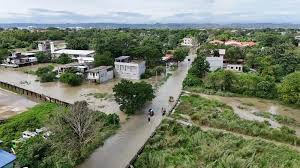
Rescue operations intensified in the Philippines on Sunday as authorities scoured lakes and remote villages for dozens of missing individuals following Tropical Storm Trami, which has claimed at least 100 lives since making landfall on October 24. The storm has been classified as one of the deadliest to hit the Southeast Asian nation this year. According to the national disaster agency, more than half a million people have been displaced, with at least 36 individuals reported missing. In the hardest-hit Bicol region, police have recorded 38 fatalities, predominantly from drowning.
Bicol regional police director Andre Dizon stated, “We are still receiving many calls and we are trying to save as many people as we can.” He expressed hope that there would be no further loss of life, though many residents in Camarines Sur province remain trapped on rooftops and upper floors of their homes. The death toll in Batangas, south of Manila, has climbed to 55, as reported by provincial police chief Jacinto Malinao. Tragically, two fatalities were linked to electrocution and drowning incidents in Cavite province. An additional five bodies were recovered from various locations, bringing the total confirmed deaths to 100. Edgar Posadas of the Civil Defence Office warned that the death toll could rise further as rescuers gain access to previously isolated areas. Search efforts are currently focused on Taal Lake in Batangas, where a family of seven is missing after their home was swept away by floodwaters.
Malinao described the devastation: “The waters from the mountains hit their home in Balete town, causing it to be swept away with them possibly inside.” Most fatalities in Batangas have been attributed to rain-induced landslides, with over 20 bodies recovered from debris. The national disaster agency reported that approximately 560,000 people have been affected by the flooding, which has submerged hundreds of villages in northern parts of the Philippines. Each year, the country faces about 20 major storms and typhoons, which wreak havoc on infrastructure and claim lives. Recent studies indicate that storms in the Asia-Pacific region are becoming more intense, forming closer to coastlines, and lasting longer over land—effects that are being exacerbated by climate change. Rescuers remain committed to locating and retrieving all missing individuals, as the nation grapples with the aftermath of this devastating storm.
Trevor Noah opens up about his mental health and leaving ‘The Daily Show’

Trevor Noah recently opened up about his life and career in an insightful interview on Steven Bartlett’s “The Diary of A CEO” podcast. The acclaimed comedian reflected on his unexpected challenges while hosting “The Daily Show”, revealing that the role took a significant mental toll on him. Noah candidly admitted, “It was terrible. You know when they say ‘be careful of what you wish for’? It was a challenge. It was absolutely terrible because I stepped into a role that I quickly learned was not just a position; it was a post in a way.” His remarks highlighted the immense pressure he faced in a position that came with high expectations. When Bartlett inquired about the role of race in his experience, Noah acknowledged that while he didn’t want to attribute everything to race, he recognized how his background made him feel different in the role. He stated, “Me being different in my colour to Jon Stewart probably makes a person feel like I’m more different to him when I’m sitting at the desk.
” Noah shared harrowing experiences of receiving death threats during his time on the show, including hateful comments and emails urging him to “go back where he came from.” He reflected on the painful realization that the hatred directed at him was often rooted in an aversion to his very presence on the show: “You hate the idea of me and you hate what I’ve done to your world.” Despite these challenges, Noah expressed gratitude for his time on “The Daily Show”. “I learned so much… I’m eternally grateful for them. But I felt like it was time” to move on, he said. The conversation also touched on the broader issue of men’s mental health. Noah pointed out that many men struggle with their mental well-being due to societal expectations that discourage emotional expression. “The sad truth is that a lot of guys have punished other guys for being vulnerable and for being themselves,” he explained, highlighting the need for a shift in how masculinity is perceived. As he continues his journey beyond “The Daily Show”, Noah’s reflections resonate as a powerful reminder of the complexities surrounding mental health, identity, and the pressures of public life.